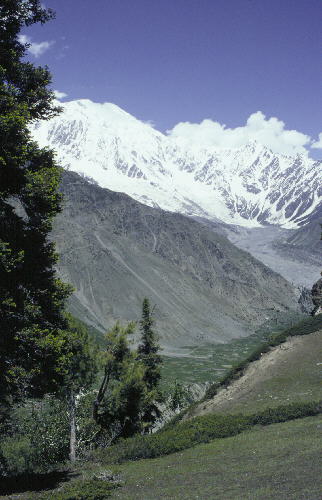
1/
View north from Rupal-Chhichi Ridge over Rupal Valley, and the
Chongra
Glacier, on the eastern flank of the Nanga Parbat massif, northern
Pakistan
Himalaya. A major ductile S/C mylonite thrust-sense shear zone,
dipping
moderately northwest, derived from granitic rocks, outcrops on both
sides
of this part of the Rupal Valley. It continues on the eastern side
of
the
Chongra Glacier. Granitic gneiss containing a cordierite-sillimanite
assemblage
forms the higher elevations in the core of the Nanga Parbat massif
above
Rupal Valley and west of the Chongra Glacier.The Rupal Shear Zone is
one
of the primary accommodation structures for the exceptionally rapid
late
Neogene-Recent uplift of the Nanga Parbat-Haramosh Massif. Chongra
Peak,
on the left, 6830m, about 12km distant; floor of the Rupal valley in
this
area is close to 3000m. Photo © 1996 W.S.F. Kidd.
.
.
.
.
.
.
.
.
.
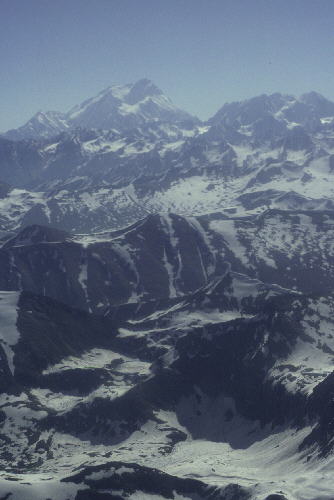
2/
Nanga Parbat Massif, northern Pakistan Himalaya, seen from
aircraft
flying
near the Babusar Pass, 50km WSW of the peak [8125m]. 40Ar/39Ar
biotite
cooling ages from metasedimentary rocks in the foreground and
middle
distance
range from about 40-20 Ma in contrast to the much younger 5-1 Ma.
ages
from the core of the Nanga Parbat massif seen in the distance.
Major
thrust-sense
shear zones separate the two cooling domains on both western
[located
in
the photo along the boundary of the higher topography] and eastern
sides
of the massif, and are the primary accommodation structures, along
with
large-scale antiformal folding, for the young and exceptionally
rapid
uplift
of the high-grade granitoid gneisses in the core of the massif.
Photo
©
1996 W.S.F. Kidd.
.
.
.
.
.
.
.
.
.
.
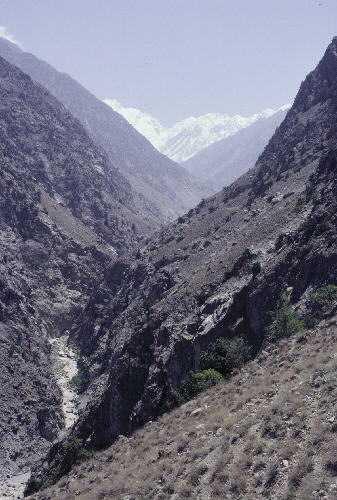
3/
View ESE up the valley of Diamir Gah, western margin of Nanga
Parbat
Massif,
northern Pakistan Himalaya. Summit of Nanga Parbat [8125m] on left
of
snowy
range is 23 km. distant. Rocks of mainly granitic origin are
deformed
in
a major 5km-wide thrust-sense steeply east-dipping ductile shear
and
brittle
fault zone exposed in cross-section in this valley (foreground to
2000m
high dark mountainside on left in middle distance). This shear
zone is
one of the primary accommodation structures for the young and
exceptionally
rapid uplift of the high-grade granitoid gneisses of the core of
the
massif.
A strong gradient in 40Ar/39Ar biotite cooling ages is localized
by
this
shear/fault zone, with very young ages of 5-1 Ma in the shear zone
and
the core of the Nanga Parbat massif. Rapid exhumation of the
massif
must
be dominated by erosion, expressed in this photo by the
impressively
steep
topography, since no large structure allowing tectonic denudation
has
been
found. Photo © 1997 W.S.F. Kidd
See “Tectonics of Nanga Parbat, western Himalaya: Synkinematic
plutonism
within the doubly vergent shear zones of a crustal-scale pop-up
structure”
by D. A. Schneider et al., Geology, 27, 999-1002.
Return to
Bill's
index page