Outline geological map of the Nanga Parbat-Haramosh Massif
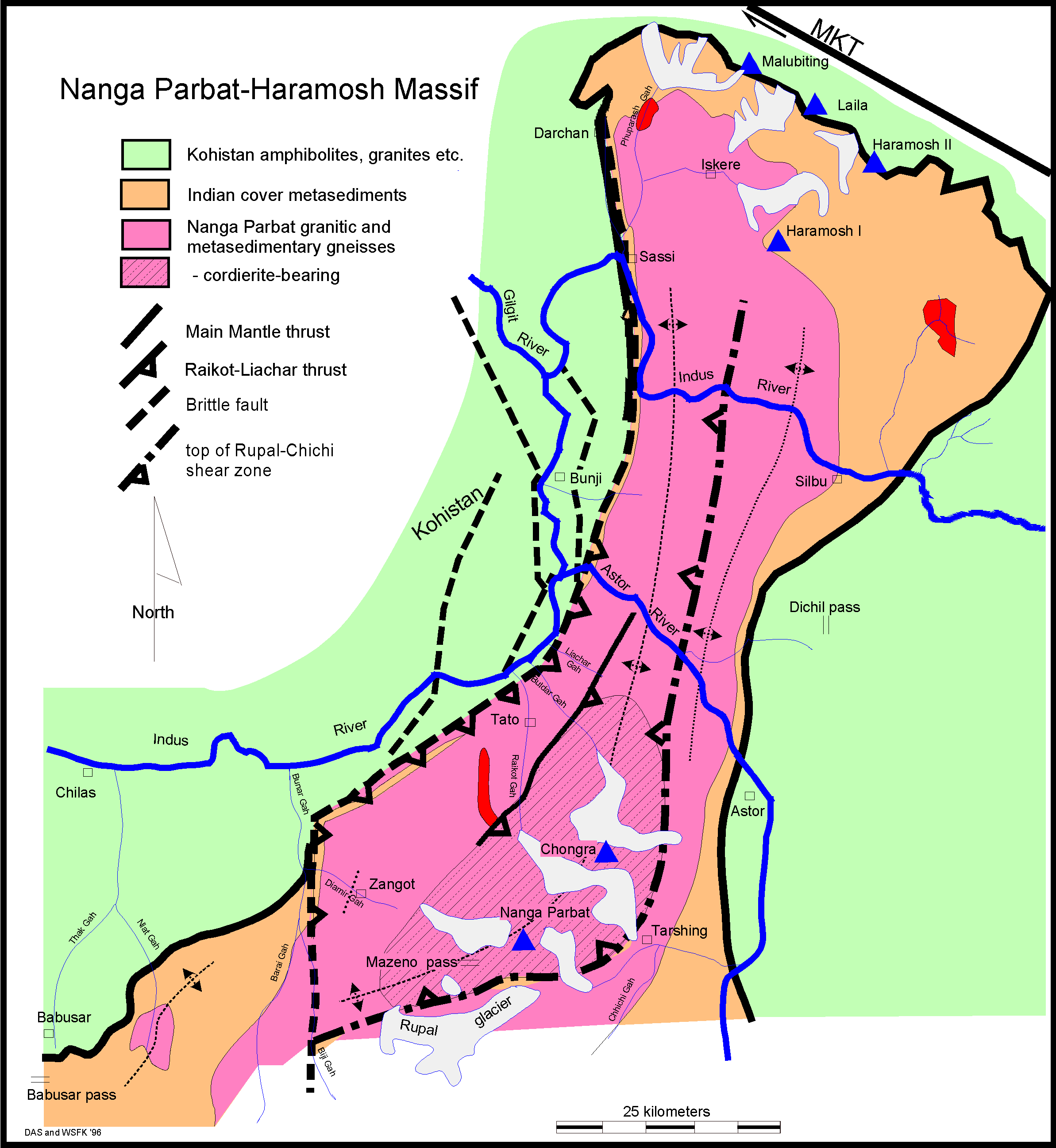 Granitoid
and metasedimentary gneisses of the Indian continental basement
form the
core of the NPHM. They are mantled by metasedimentary rocks
derived from
the pre-collisional passive margin cover of India. Along the
eastern, northern
and southwestern portions of the margin, rocks of the
Kohistan-Ladakh island
arc suite contact these across the mylonites of the Main Mantle
Thrust
[MMT], which has been distorted by the rise of the NPHM into a
large crustal-scale
antiformal fold. This antiformal structure has been modified by
overthrusting
to the NW along the central part of the western margin
[Raikot-Liachar
Thrust]. The regional antiform is more complex in detail, with two
recognisable
antiforms separated by a zone of mylonites, including pelitic
schist and
amphibolite. In the Astor River section, the mylonites form a
“pinched”
syncline, characteristic of basement-cover contacts. We interpret
this
newly recognised zone to connect with the Rupal-Chhichi Shear Zone
south
east of Nanga Parbat peak. This zone of east/southeast-directed
thrusting
combines with the Raikot-Liachar Thrust on the western margin of
the NPHM
to produce a large-scale “pop-up” structure for the core of the
NPHM.
Granitoid
and metasedimentary gneisses of the Indian continental basement
form the
core of the NPHM. They are mantled by metasedimentary rocks
derived from
the pre-collisional passive margin cover of India. Along the
eastern, northern
and southwestern portions of the margin, rocks of the
Kohistan-Ladakh island
arc suite contact these across the mylonites of the Main Mantle
Thrust
[MMT], which has been distorted by the rise of the NPHM into a
large crustal-scale
antiformal fold. This antiformal structure has been modified by
overthrusting
to the NW along the central part of the western margin
[Raikot-Liachar
Thrust]. The regional antiform is more complex in detail, with two
recognisable
antiforms separated by a zone of mylonites, including pelitic
schist and
amphibolite. In the Astor River section, the mylonites form a
“pinched”
syncline, characteristic of basement-cover contacts. We interpret
this
newly recognised zone to connect with the Rupal-Chhichi Shear Zone
south
east of Nanga Parbat peak. This zone of east/southeast-directed
thrusting
combines with the Raikot-Liachar Thrust on the western margin of
the NPHM
to produce a large-scale “pop-up” structure for the core of the
NPHM.
Return to Abstract/Index