State University of New York at Albany - Edward
Durell Stone's architecture, atmospheric science, and the
geology under it
In the warmer months, a
pleasant and distinctive campus
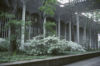
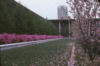

but.... in winter, the wind
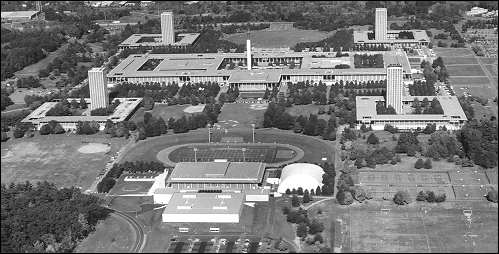
 One distinctive feature of the Albany campus is
the excellent alignment of the long axis of the main structure, the
academic podium, with the prevailing WNW wind direction, especially
for strong winds in winter. The tunnel-like geometry of the three-story
buildings with the uniform overhanging colonnade roof tends to
funnel and strengthen the wind near the structures and the straight
access roadways adjacent. Since temperatures in Albany in the winter
months rarely get much above freezing, the vehicle-free pleasure of
walking on the "podium" that Stone intended in his design is at
those times rather reduced.
One distinctive feature of the Albany campus is
the excellent alignment of the long axis of the main structure, the
academic podium, with the prevailing WNW wind direction, especially
for strong winds in winter. The tunnel-like geometry of the three-story
buildings with the uniform overhanging colonnade roof tends to
funnel and strengthen the wind near the structures and the straight
access roadways adjacent. Since temperatures in Albany in the winter
months rarely get much above freezing, the vehicle-free pleasure of
walking on the "podium" that Stone intended in his design is at
those times rather reduced.
The dunes, moving again after 10,000 years
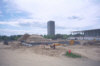 The campus is built on sand (no smart biblical
allusions, please), a deposit of dunes blown by howling peri-glacial
winds across the bare floor of glacial Lake Albany just after it
drained, about 10,500 years ago. The source of the sand was the
exposed delta of the ancestral Mohawk River deposited from its
outlet near Schenectady into Lake Albany. The sands are quite
variable in thickness, typically 50 feet or more, with dune heights
of up to 50 feet above this, and are underlain by varved clays
previously deposited in Lake Albany. As the climate warmed during
late deglaciation of North America, the dunes became stabilised by
vegetation, with a distinctive pitch pine, fire-mediated pinebarren
ecosystem established (known locally as the Albany Pine Bush),
before European-derived people began their modifications to the
continent. [more
detail for the geology under the uptown campus; and the groundwater;
flow
map]
The campus is built on sand (no smart biblical
allusions, please), a deposit of dunes blown by howling peri-glacial
winds across the bare floor of glacial Lake Albany just after it
drained, about 10,500 years ago. The source of the sand was the
exposed delta of the ancestral Mohawk River deposited from its
outlet near Schenectady into Lake Albany. The sands are quite
variable in thickness, typically 50 feet or more, with dune heights
of up to 50 feet above this, and are underlain by varved clays
previously deposited in Lake Albany. As the climate warmed during
late deglaciation of North America, the dunes became stabilised by
vegetation, with a distinctive pitch pine, fire-mediated pinebarren
ecosystem established (known locally as the Albany Pine Bush),
before European-derived people began their modifications to the
continent. [more
detail for the geology under the uptown campus; and the groundwater;
flow
map]
When the
site was cleared for the new University campus in the early
1960's, the sand started moving again and, despite efforts being
made to stop the large-scale movement, dust and sand were a
persistent nuisance to those who were early occupants of completed
buildings before the last of the original buildings was finished in
1968 and the ground revegetated (or paved). A few remnants of
original dunes can be seen near the pond on the campus; a few
kilometers farther west there are extensive preserved
areas of the Pinebush containing large dunes, and sections cut
through some dunes can be seen on the margins of nearby
Interstate-90.
The northwest corner of the uptown campus was not long ago an
unmodified dune with mature pinewoods; most regrettably this area
was entirely destroyed to build additional dormitory accommodation.
Those now not-so-new dorms are no match
for the architectural distinction of the original campus.
[map
showing the dunes in the area around the University before its
construction]
SUNYA architectural pages:
The
official university history; construction
pictures
Edward Durell Stone
website
Look-alike competition winner - the Pakistan
Institute of Nuclear Science and Technology (another Stone
design)
Return to: geolinks, or geology
undergraduate page, or Bill's scrapbook