

Geology undergraduate programs and majors c. 1965 - 2006
This page and links on it
are only for the historical record; the Geology
undergraduate programs were suspended in May 2006
due to inadequate faculty
resources being provided to sustain them. The last Geology majors
graduated in May 2009.
History of undergraduate degree programs in Geology
Until 1996, there were two majors offered in the Department of
Geological Sciences (DOGS).
The BS degree program in
Geology, continued until suspension
of this major in 2006.
The BS
degree program in Earth Science, for prospective Earth Science
high school teachers.
They continued in the Program in
Geological Sciences (PIGS) in the Department of Earth &
Atmospheric Sciences, from the time of the merger
with Atmospheric Sciences in Fall 1996. The BS degree program in Earth
Science was
discontinued after 2000, because of changes in New York State
Education Department rules for degree requirements. After this, to
qualify for certification, students at Albany had to define and
complete:
a Student-Initiated
Interdisciplinary B.S. major in Earth Science, followed by a
subsequent MS degree in the
School of Education, or elsewhere.
In the Geology BS major, double majors in geology-math,
geology-physics, geology-chemistry, or geology-computer science were
encouraged for interested and qualified students. A combined BS/MS
degree in Geology was also offered for qualified students.
From 1996 an Honors Program was offered for qualified majors.
Geology, and Earth Science BS majors combined a major and minor from
the required courses within their degree, although they could choose
in addition to declare a specific minor in another field. A separate
minor in Geology was available to students in majors other than
Geology or Earth Science. This required a minimum of 20 credits in
courses in Geological Sciences, including 9 credits in courses with
prerequisites of Geology courses.
The requirements for the undergraduate majors were, along with
course descriptions, included in the University at Albany
Undergraduate Bulletin published yearly;
an example, the Geological Sciences pages from the bulletin for the
1990-91 academic year.
For a short interval, there was a brochure for promotion of the
Geological Sciences undergraduate program and majors (1999 version; 2004 version).
Special Programs and Opportunities that were
provided in the Geological Sciences degree programs
The Department co-sponsored a seminar
series every semester from 1975 through 2008 that provided
students with a sampling of significant topics in current research
in talks presented by outside speakers from research universities
and institutions. Seminars were also presented each semester by all
graduate students on their research. All these seminars were open to
interested undergraduates.
Undergraduates could do an internship in Albany at the New
York State Geological Survey, NY
State Department of Environmental Conservation (DEC), Dept
of Transportation (DOT), U.S.
Geological Survey (water resources office in Troy), or with
private environmental/geoscience companies. Interested
undergraduates could also assist in the research program of a
faculty member.
Albany is located amongst by far the most richly varied geologic
setting of any of the SUNY University centers, making it superior
for field-based education, which was always a particular strength
of the Department of Geological Sciences. The Geology BS Program
had 3 courses that involved significant geological field
experience, and required for majors. The University provided vehicles to the Department from 1975
on to support provision of these courses, which were:
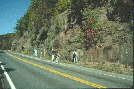
in the fall semester - a course at the 200-level including
principles of stratigraphy, sedimentary processes,
an introduction to determination of relative and quantitative
geochronological ages, and field geological methods;
6 to 10 all-day weekend trips were run every year from 1975 to
2009, in September and October, to locations up to about an hour's
drive from Albany.
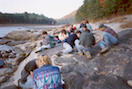
in the spring semester - a course at the 300-level for introductory
Structural Geology;
4 to 6 all-day weekend trips were run from 1997 to 2010 every year
in late March and April, to locations up to about an hour's drive
from Albany.
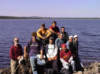
the senior-level Field
Mapping course, which was run over three weeks full time in
August;
from 1974 to 2000, and in 2006 this was at places that changed
from year to year, all in the Taconic deformed zone in eastern New
York and adjacent Vermont; from 2001-2005 it was held at
Chesunkook Lake in Maine. It was not offered after 2006.
The other two courses were continued until fall 2010. After Bill
Kidd's retirement in December 2010, extensive field-based
geological education ceased abruptly at the University at Albany.
In 2012, the administration placed payment for vehicle fuel and
maintenance onto the Department expense budget without providing
any additional funds to cover these expenses, nor for substitute
rentals, so even if qualified faculty were to have been available,
providing similar educational enrichment was rendered impossible.
The Department of Earth and Atmospheric Sciences formed
by merger in 1996 began offering these undergraduate degrees which
included some content of the Geological Sciences:
From 1999 there was a B.A.
degree program in Earth and Atmospheric Science;
and from 2002, the B.S. degree
program in Environmental Science was started.
The Department was renamed in 2009 to Atmospheric &
Environmental Sciences. After 2010, the diminishing number of
faculty at Albany qualified in the Geological Sciences made
problematic the provision of the Geology concentration, or any
significant geological content in these degrees.
Geology is an essential component of studies to understand the
surface environment of the Earth, including Global Climate Change,
resource discovery and limits, environmental hazards and their
possible mitigation, and satisfactory prevention or remediation of
subsurface pollution. The lack of this component became a
significant defect in these degree programs. And there are other
reasons to think that the loss of Geology degree programs is
academically deplorable for this or any university [see the link
below, to the significance and value of a knowledge of the
Geological Sciences] .
Faculty
The faculty were strongly committed to undergraduate teaching.
Geology courses in the Geological Sciences were normally taught by
the faculty, including freshman level courses. The faculty generally
received high teaching evaluations; one faculty member, Dr. John
Delano, was a Distinguished Teaching Professor. Sophomore through
senior level courses were a reasonable size (10-20 students),
promoting individual attention by faculty, and by teaching
assistants in laboratory sections under faculty supervision.
Faculty published regularly in leading scientific journals, and were
well known internationally in the geosciences.
And here's another way to express the
significance of the geological and atmospheric sciences
Geology, atmospheric sciences
and architecture of the State University at Albany uptown campus
Return to Geological Sciences index page
Last revision: 2026/01/06