
Analogue Microstructural Modelling at the
University
at Albany, State University of New York
Youngdo Park, Jin-Han Ree & Win Means
Introduction
There are 15 time-lapse movies linked to this page, which show the
experimental
deformation or post-deformation behaviour of octachloropropane (C3Cl8).
Most
of the experiments on this page were performed during December 1995,
when JHR was visiting Albany. Feel free to download these movies for
teaching.
The order of the movies is such that the experimental strain
rate decreases
and temperature increases.
Octachloropropane (OCP hereafter) is an organic material with
hexagonal
crystal symmetry. Polycrystalline OCP shows "similar(?)"
microstructures
to those found in quartzite. The material has been used to study
various
deformation processes by many workers (Win Means, Janos Urai, Mark
Jessell,
Jin-Han Ree, Paul Bons, Coen ten Brink, Cees Passchier), and is
probably
being used for the same purpose, even now somewhere on Earth (see
Ree,
1994, J. Struct. Geol. vol. 16, 403-418 for details of the
experiments).
Nearly simple shearing grips (grips imposing simple shearing
with a
small "transpressional" component) were used for deformation, except
in
Movie 04 which shows a pure shear deformation experiment.
The horizontal dimension of the movies is ~1.5 mm.
Movie Format
Each experiment has been converted into QuickTime format. These can
be
viewed directly assuming you have a QuickTime viewer attached to
your browser.
If not, download it from the QuickTime
site.
Hints:
a) The movies display better if the monitor is set to more than
256
colours.
b) Set the QuickTime player to display All Frames
In order to download any one of these movies, simply click on
the  icon
to the right of the sample frames.
icon
to the right of the sample frames.
Movie 00: Cataclastic deformation
The sample is already deformed at the beginning of the movie. A
sub-horizontal
high strain rate zone or fault, marked by darker color, develops in
the
lower part of field. Some high strain rate zones, oriented at high
angles
to the shear direction, show the opposite sense of shear to that
expected.
Although concentrated shearing probably takes most of the bulk
straining,
some grains still deform internally. The last frame in the movie was
taken
with plane polarized light and shows the void spaces created during
deformation.
In this movie  becomes
  475k
475k
Movie 01: Grain boundary opening
In the lower part of the pictures, a grain boundary starts to open
at the
expected orientation during sinistral shearing. Near the end of the
movie,
a feature which resembles a transform fault connecting two openings
(ridges)
develops. Incipient opening at grain boundaries can also be seen at
the
end.
In this movie  becomes
  425k
425k
Movie 02: Formation of subgrains by rotational recrystallization
Irregular grain boundaries and small subgrains near grain boundaries
form
during deformation. The grain near the center of the field of the
view
becomes sigmoidal in shape as deformation progresses. The grains in
the
top right of the movie show extensive grain boundary sliding as the
experiment
progesses. Also follow the behaviour of these two grains in the
bottom
right  as
the boundary
between them switches from a grain boundary migration process to a
grain
boundary sliding process.
as
the boundary
between them switches from a grain boundary migration process to a
grain
boundary sliding process.
In this movie  becomes
  1123k
1123k
Movie 03: Post-deformational, microstructural changes of the
sample of
Movie 02
This movie records changes of microstructures after deformation. Can
you
tell the shear sense from the last pictures? How do the grains that
survive
until the end of movie originate? Observed at the same temperature
as the
preceding deformation.
In this movie 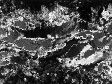 becomes
 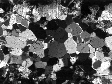 756k
756k
Movie 04: Subgrain boundary formation and grain boundary migration
Sets of subgrain boundaries form within grains. The trace of these
subgrain
boundaries is subparallel to the c-axis orientation. Grain boundary
migration
can also be seen.
In this movie 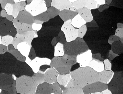 becomes
 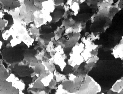 301k
301k
Movie 05: Post-deformational, microstructural changes of the
sample of
Movie 04
Grains change into nearly equilibrium texture of polycrystalline
material
in the end. There is also mysterious vertical lengthening (~5%)
while the
motor was off. Observed at the same temperature as the preceding
deformation.
In this movie 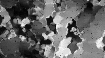 becomes
  599k
599k
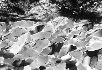
Movie 06: Contrast in deformation microstructures among domains of
different
strain rate
In this movie, a strain rate gradient in the vertical direction can
be
seen. Differences in microstructures such as foliation intensity,
orientation
and subgrain boundary density can be seen along the direction of
strain
rate gradient.
In this movie 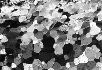 becomes
  799k
799k
Movie 07: Post-deformational, microstructural changes of the
sample of
Movie 06
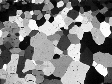
This movie shows how the rates of grain growth - strain energy
driven or
surface energy driven, are different for the strain rate domains of
Movie
06. At the beginning, the process of grain growth in the high strain
rate
domain seems to be faster than that of the low strain rate domain.
However,
with time, the rate of grain growth seems to be faster in the low
strain
rate domain, resulting in coarser grained texture in this domain in
the
end. Observed at the same temperature as the preceding deformation.
In this movie 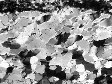 becomes
  2221k
2221k
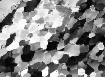
Movie 08: Nearly identical rates of subgrain boundary migration
across
grain boundaries
This feature can be seen in the grains near the center of the field.
In this movie 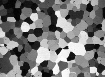 becomes
  211k
211k
Movie 09: Development of high strain rate zones and formation of
"ribbons"
in the zones
Shearing is localized in the two zones near the top and bottom of
the field.
In these zones, subvertical alignment of subgrain boundaries can be
seen.
At the end, the upper zone consists, at least in terms of the c-axis
orientations,
nearly a single grain, which resembles quartz ribbons.
In this movie  becomes
  2478k
2478k
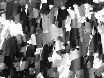
Movie 10: Subgrain boundary migration and grain size increase
Subgrain boundaries, oriented subvertically, migrate during
deformation.
Subhorizontal relative motions of markers within some grains can be
seen,
and this suggests that the slip planes of these grains are also
subhorizontal
or perpendicular to the subgrain boundaries. Since the traces of
subgrain
boundaries are subparallel to the c-axes, the observed motion of
markers
suggests slip on the basal planes.
In this movie 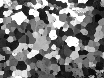 becomes
  1256k
1256k
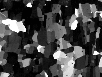
Movie 11: Post-deformational, microstructural changes of the
sample of
Movie 10
In contrast to the previous examples, the microstructure of this
sample
remains about the same. This suggests that (1) microstructures with
high
subboundary density may be stable, or (2) microstructures in this
sample
do not change due to the initial low defect density, acquired during
low
strain rate deformation. Observed at the same temperature as the
preceding
deformation.
In this movie 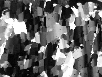 becomes
  949k
949k
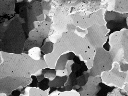
Movie 12: Grain boundary migration during high temperature
deformation
High mobility of grain boundaries can be seen in this experiment
performed
near the melting point. This experiment also shows reversal of
shear-sense,
obtained by reversing the drive motor. Microstructures do not seem
to have
a good memory of older shear-sense.
In this movie 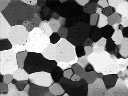 becomes
  709k
709k
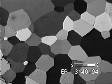
Movie 13: Grain growth at zero strain rate
The numbers at the bottom right indicate time (hr:min:sec) after the
first
frame of the movie. Can you find an area which was swept twice by
migrating
grain boundaries?
In this movie 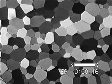 becomes
  615k
615k
Movie 14: Grain growth in a partial melt system
Some of the grain boundaries in this movie are wet by a melt, which
is
OCP saturated acetone. Similar grain growth to that of Movie 13 can
be
seen. Is the wetting angle changing during migration of boundaries?
"Marker"
particles that drift across the field of view are probably in melt
film
between sample and glass.
In this movie  becomes
  280k
280k
We thank our teacher, Professor W.D. Means for bringing us into
this
interesting field and his continuous support while we were at
Albany. This
work was supported by NSF grants to EAR-9017478 & EAR-9404872 to
W.D.
Means, and KOSEF grant 941-0400-003-2 to J.-H. Ree.
This page was assembled 19/6/96 by Mark Jessell and any mistakes
are
probably his fault (these have been reduced in this 2003-06-11
transported
and edited version [WK] :-) .
Return to Win Means' page
Return to Geosciences index page